
In this conference update video, Profs. Wolfgang Janni, Sherko Kümmel and Michail Ignatiadis provide key insights from the highly anticipated ESMO Breast Cancer 2025 Satellite Symposium, sponsored by Menarini Stemline. 


The esteemed faculty discusses treatment strategies and sequencing options after ET + CDK4/6i for patients with ER+/HER2- metastatic breast cancer (mBC).  


Topics of discussion include:  

  • Overview of the updated ESMO mBC living guidelines
  • Overcoming endocrine resistance after 1st line ET + CDK4/6i (intrinsic & acquired)   
  • The benefit of biomarker-selected endocrine-based therapies in ER+/HER2- mBC 
  • ESR1 mutation: clinical significance and testing strategies 

Clinical takeaways

  • 2nd line treatment choices are defined by the eligibility to receive endocrine therapy and a driven by biomarker status. For patients with retained endocrine-sensitivity guidelines recommend exhausting sequential ET-based regimens in 2L+ settings.  
  • Real world evidence of single agent elacestrant shows improved results versus EMERALD study, reflecting its use in the endocrine sensitive population.  
  • In tumors retaining endocrine-sensitivity and coexisting PIK3CA and ESR1 mutations, elacestrant monotherapy can be a good option before PI3K/AKT inhibitors as data shows similar efficacy with a manageable safety profile.  
  • ESR1-mut testing should be performed at 1st line progression using liquid biopsy, given disease subclonality and heterogeneity. If negative, testing should be repeated at each subsequent progression. Archival tissue should not be used, as ESR1 mutations are typically acquired. 

Professor and chair of the Department of Obstetrics and Gynecology at the University of Ulm, Germany, where he undertakes research and is principal investigator in a number of clinical studies and was previously chair in Heinrich-Heine-University, Düsseldorf. He is specialized in gynecological oncology, with a focus on breast cancer. His research received numerous international awards, including those of ASCO, AACR and SABCS. 

Prof. Wolfgang Janni has received financial support/sponsorship for research support, consultation, or speaker fees from the following companies:

AstraZeneca, Cellgene, Chugai, Daiichi Sankyo, Eisai, Exact Science, Gilead, GSK, Guardant Health, Janssen, Lilly, Menarini Stemline, MSD, Neo Genomics, Novartis, Pfizer, Roche, Sanofi-Aventis and Seagen.

Clinical Director and Chairman of the Interdisciplinary Breast Unit Clinics of Essen-Mitte in Germany, where he is also Lead of the Breast Cancer Research Program. He is also Executive Board Member of AGO and a Scientific Director of the WSG, an academic study group for breast cancer. 

Prof. Sherko Kümmel has received financial support/sponsorship for research support, consultation, or speaker fees from the following companies:

Novartis, Roche Pharma, Pfizer, Lilly, Amgen, MSD, Exact Science, Agendia, AstraZeneca, Daiichi Sankyo, Somatex, Hologic, Sonoscape, Gilead, Seagen, Menarini Stemline and PINK.

Director of the Breast Medical Oncology Clinic & Program at the Jules Bordet Institut (IJB), H.U.B. and Professor of Medical Oncology at the Université Libre de Bruxelles, Belgium. Since 2016, he has been a member of the Executive and Research Boards of IJB. Since 2021, he is the chair of the Breast Cancer Group of the EORTC.

Prof. Michail Ignatiadis has received financial support/sponsorship for research support, consultation, or speaker fees from the following companies:

Seattle Genetics, Daiichi Sankyo, AstraZeneca, Menarini Stemline, Gilead Sciences, Rejuveron Senescence Therapeutics, Novartis, Roche, Pfizer, Natera Inc, and Inivata Inc. Travel grants from Gilead, Roche and AstraZeneca.

In this conference update video, Profs. Wolfgang Janni, Sherko Kümmel and Michail Ignatiadis provide key insights from the highly anticipated ESMO Breast Cancer 2025 Satellite Symposium, sponsored by Menarini Stemline. 


The esteemed faculty discusses treatment strategies and sequencing options after ET + CDK4/6i for patients with ER+/HER2- metastatic breast cancer (mBC).  


Topics of discussion include:  

  • Overview of the updated ESMO mBC living guidelines
  • Overcoming endocrine resistance after 1st line ET + CDK4/6i (intrinsic & acquired)   
  • The benefit of biomarker-selected endocrine-based therapies in ER+/HER2- mBC 
  • ESR1 mutation: clinical significance and testing strategies 

Clinical takeaways

  • 2nd line treatment choices are defined by the eligibility to receive endocrine therapy and a driven by biomarker status. For patients with retained endocrine-sensitivity guidelines recommend exhausting sequential ET-based regimens in 2L+ settings.  
  • Real world evidence of single agent elacestrant shows improved results versus EMERALD study, reflecting its use in the endocrine sensitive population.  
  • In tumors retaining endocrine-sensitivity and coexisting PIK3CA and ESR1 mutations, elacestrant monotherapy can be a good option before PI3K/AKT inhibitors as data shows similar efficacy with a manageable safety profile.  
  • ESR1-mut testing should be performed at 1st line progression using liquid biopsy, given disease subclonality and heterogeneity. If negative, testing should be repeated at each subsequent progression. Archival tissue should not be used, as ESR1 mutations are typically acquired. 

Director of the Breast Medical Oncology Clinic & Program at the Jules Bordet Institut (IJB), H.U.B. and Professor of Medical Oncology at the Université Libre de Bruxelles, Belgium. Since 2016, he has been a member of the Executive and Research Boards of IJB. Since 2021, he is the chair of the Breast Cancer Group of the EORTC.

Prof. Michail Ignatiadis has received financial support/sponsorship for research support, consultation, or speaker fees from the following companies:

Seattle Genetics, Daiichi Sankyo, AstraZeneca, Menarini Stemline, Gilead Sciences, Rejuveron Senescence Therapeutics, Novartis, Roche, Pfizer, Natera Inc, and Inivata Inc. Travel grants from Gilead, Roche and AstraZeneca.

Clinical Director and Chairman of the Interdisciplinary Breast Unit Clinics of Essen-Mitte in Germany, where he is also Lead of the Breast Cancer Research Program. He is also Executive Board Member of AGO and a Scientific Director of the WSG, an academic study group for breast cancer. 

Prof. Sherko Kümmel has received financial support/sponsorship for research support, consultation, or speaker fees from the following companies:

Novartis, Roche Pharma, Pfizer, Lilly, Amgen, MSD, Exact Science, Agendia, AstraZeneca, Daiichi Sankyo, Somatex, Hologic, Sonoscape, Gilead, Seagen, Menarini Stemline and PINK.

Professor and chair of the Department of Obstetrics and Gynecology at the University of Ulm, Germany, where he undertakes research and is principal investigator in a number of clinical studies and was previously chair in Heinrich-Heine-University, Düsseldorf. He is specialized in gynecological oncology, with a focus on breast cancer. His research received numerous international awards, including those of ASCO, AACR and SABCS. 

Prof. Wolfgang Janni has received financial support/sponsorship for research support, consultation, or speaker fees from the following companies:

AstraZeneca, Cellgene, Chugai, Daiichi Sankyo, Eisai, Exact Science, Gilead, GSK, Guardant Health, Janssen, Lilly, Menarini Stemline, MSD, Neo Genomics, Novartis, Pfizer, Roche, Sanofi-Aventis and Seagen.

Programme summary
Watch the video now
Share this programme
This programme has been sponsored by Menarini Stemline and is intended for healthcare professionals only
Supporter Acknowledgement
This programme has been sponsored by Menarini Stemline and is intended for healthcare professionals only
I agree that this programme:

Was valuable to me

1/3
Programme summary
Share this programme
This programme has been sponsored by Menarini Stemline and is intended for healthcare professionals only
Supporter Acknowledgement
This programme has been sponsored by Menarini Stemline and is intended for healthcare professionals only
I agree that this programme:

Was valuable to me

1/3

Other programmes of interest

conference-update Conference update

Episode

3

of 3

episode
Oncology 
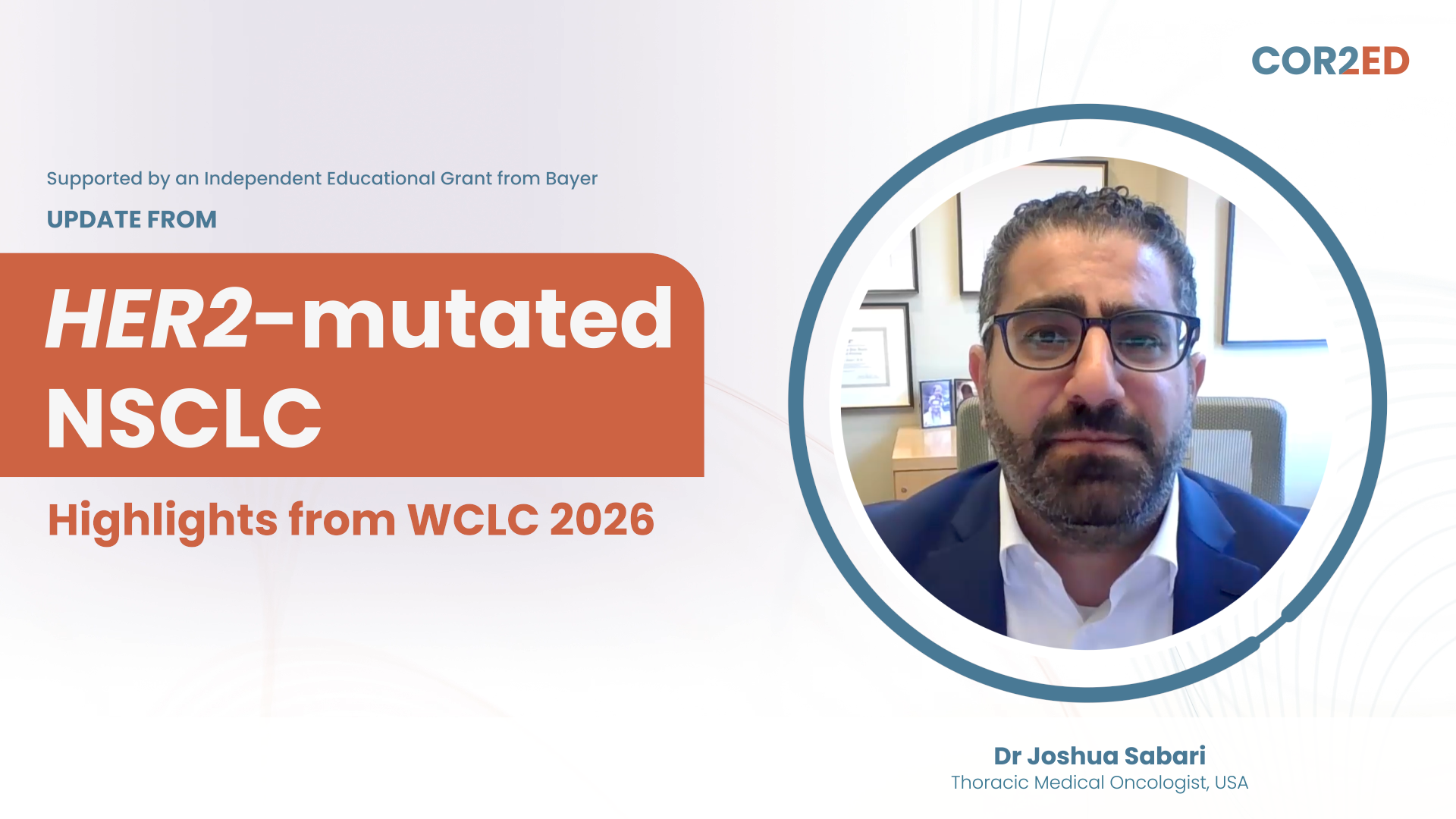
How are new data shaping the landscape in HER2-mutant NSCLC?

Insights from WCLC 2026

Experts
Dr Joshua Sabari
Endorsed by
ICAN international cancer advocacy network Biomarker Collaborative Exon20group
  • download Downloadable
    Resources
  • clock 5 MIN
  • calendar Sep 2026

Educational programme supported by an Independent Educational Grant from Bayer.
conference-update Conference update
Oncology Hemato-oncology 
Myelofibrosis: Navigating unmet needs and overcoming clinical challenges

Expert perspectives on clinical trial highlights from EHA 2026

Experts
Prof. Francesco Passamonti, Prof. Claire Harrison
  • download Downloadable
    Resources
  • clock 6 MIN
  • calendar Sep 2026

Brought to you by COR2ED Medical Affairs in collaboration with Menarini Stemline. This programme is intended for HCPS outside the UK. MED---2600258