Struggling to stay awake during the day can be mistaken for normal tiredness, but ongoing daytime sleepiness can be a sign that something is not quite right. 


Along with feeling sleepy during the day, some people may also experience other symptoms, such as sudden muscle weakness, very vivid dreams, feeling unable to move when falling asleep or waking up, and/or disturbed sleep at night. When these symptoms happen together, they may point to narcolepsy. 


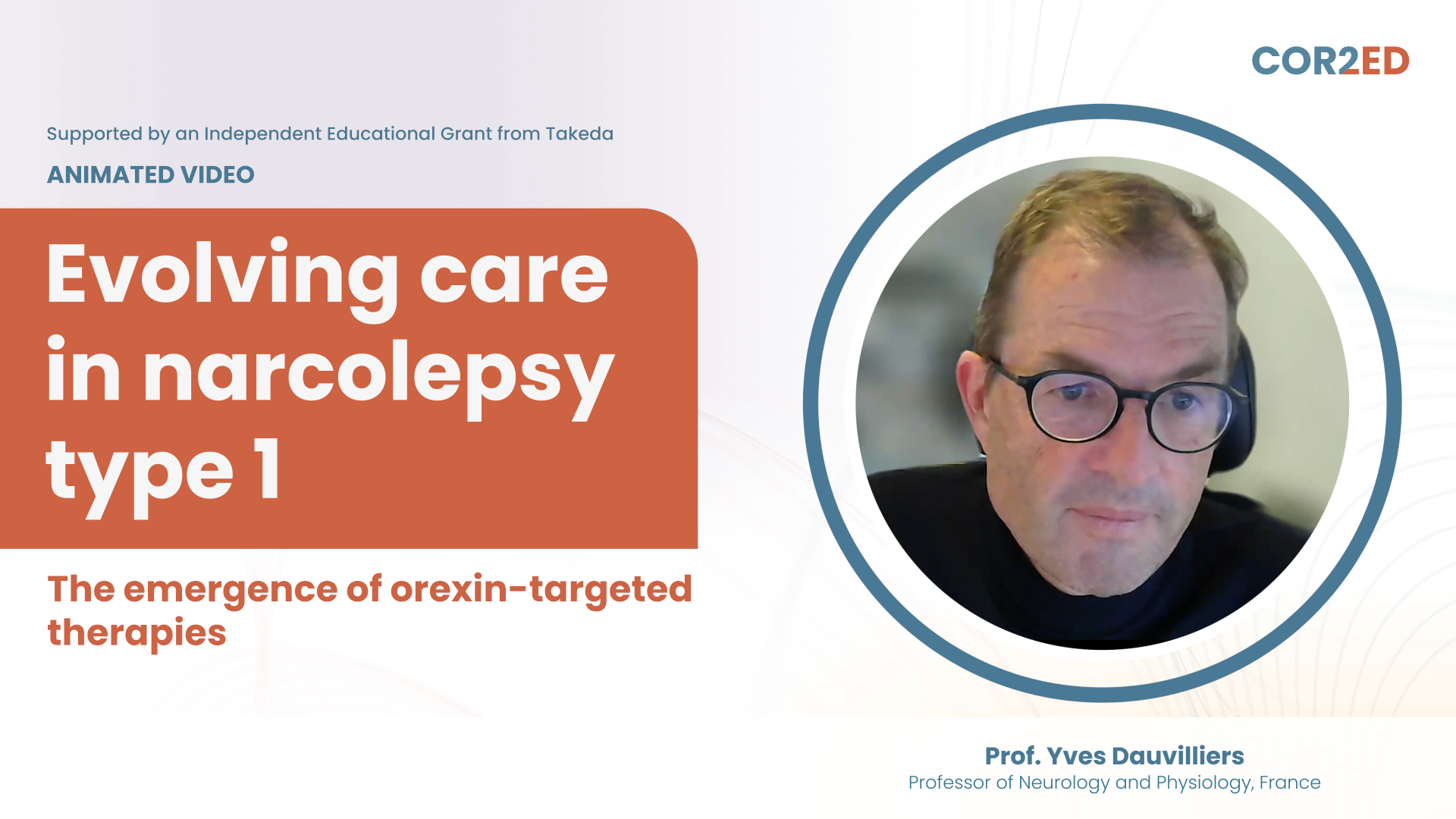
In this video, sleep expert Professor Yves Dauvilliers explains narcolepsy and how to recognise it, including: 

  • Normal tiredness vs excessive daytime sleepiness 
  • What narcolepsy is
  • When and where to seek help 


Clinical takeaways

  • Feeling sleepy all the time is not normal. Struggling to stay awake during the day may be a sign of an underlying issue that may require further attention 
  • When ongoing sleepiness happens together with other symptoms, such as sudden loss of muscle strength, very vivid dreams, feeling unable to move while lying in bed, and/or waking up often during the night, it could be narcolepsy 
  • For many people, narcolepsy is linked to low levels of orexin, a brain chemical that regulates wakefulness. Early diagnosis is important to help manage it appropriately with available treatments 
  • Recognising these signs and speaking with a doctor is the first step in understanding what may be happening and accessing appropriate care as early as possible 
  • Recognise the signs and symptoms of narcolepsy
    Help people understand the key features that set narcolepsy apart from other conditions, such as sudden muscle weakness (cataplexy), excessive daytime sleepiness, and disrupted night-time sleep and why these symptoms should not be ignored 
  • Understand the importance of early diagnosis
    Having the right tests and speaking to a healthcare professional early can help prevent years of misdiagnosis and improve quality of life 
  • Learn what causes narcolepsy type 1
    Find out how narcolepsy type 1 is linked to low levels of orexin, and how this affects symptoms like sleepiness, cataplexy, and other related health issues 

Prof. Yves Dauvilliers is a director of the Sleep Disorders Centre, Department of Neurology, Gui de Chauliac Hospital, Montpellier since 2005, coordinator of the National Reference Network for Orphan Diseases: Narcolepsy and Idiopathic Hypersomnia.
He became a specialist in Neurology, Montpellier University, 1995, obtained univ. diploma, “Clinical Neurophysiology”, Montpellier, 1997, “Wake and Sleep”, France, 1998, wrote medical thesis, “Genetic and familial aspects of narcolepsy”, Montpellier, 2000 and PhD thesis in Neurosciences, “Neurobiology and Genetics of Narcolepsy”, Montpellier, 2004. He became a Professor of Neurology-Physiology in 2008. He obtained post doc training at Centre d’études du sommeil, Hopital du Sacré-Coeur, Montreal, Canada, 2006 and -HUG Belle Idée, Neuropsychiatric Division, Chene-Bourg, Switzerland, 1999, 2001
He serves as a reviewer for Lancet, NEJM, Brain, Annals of Neurology, Neurology, Journal of Neurology, Neuropsychiatry and Neurosurgery, Sleep, Journal of Sleep Research, Sleep Medicine, Brain, Archives of Internal Medicine, Editor in Chief for the journal: Frontiers in Neurology, Section “Sleep and Chronobiology”. He is a member of the Editorial Board for the journal: Sleep Medecine, SLEEP, Sleep Medicine Review and behavioural neurology.
He is a member of Scientific Committee of the EU NN, ESRS, SFRMS, AASM, Co-chair of the Centre of Excellence in neurodegeneration, Montpellier, Coordinator Axis Central Hypersomnia – GDR Sleep, Vice-President of EU RLS Study Group.
The main domains of his research are studies in the diagnosis, epidemiology, pathophysiology and therapy of sleep disorders related to neurological disorders including narcolepsy, hypersomnias, parasomnia, insomnia, Parkinson, Alzheimer and RLS.
Prof. Dauvilliers is a author or coauthor of 459 papers published in international and national peer-reviewed journals (including Lancet, Lancet Neurol, Science, Nature Genetic), h index: 67 WOS.

Programme summary
  • clock Duration 2 MIN
  • clock Language(s) flag
Watch the video now
Share this programme
This educational programme is supported by an Independent Educational Grant from Takeda
Supporter Acknowledgement
This educational programme is supported by an Independent Educational Grant from Takeda
Endorsement
I agree that this educational programme:

Was valuable to me

1/4
Brought to you by
SLEEP CONNECT

SLEEP CONNECT is an initiative of COR2ED, supported by an Independent Educational Grant from Takeda.

Meet the experts Independent IME approved

Other programmes of interest

patient-support Patient Support

Episode

2

of 2

episode
Oncology Endocrinology Rare diseases 
Thriving beyond an EP-NEC diagnosis

Perspectives on treatment and care 

Experts
Jessica Thomas
Endorsed by
NET-Research-Foundation Minkhas mission
  • clock 4 MIN
  • calendar Dec 2025
  • Non-accredited Independent Medical Education

Educational programme supported by an Independent Educational Grant from Boehringer Ingelheim 
patient-support Patient Support

Episode

1

of 2

episode
Oncology Endocrinology Rare diseases 
Navigating extrapulmonary neuroendocrine carcinoma (EP-NEC)

Insights for patients and care partners 

Experts
Meredith Cummins
Endorsed by
INCA
NeuroEndocrine Cancer Australia Neuroendocrine Cancer Foundation NET-Research-Foundation
Neuroendocrine Cancer UK Minkhas mission
  • clock 5 MIN
  • calendar Dec 2025
  • Non-accredited Independent Medical Education

Educational programme supported by an Independent Educational Grant from Boehringer Ingelheim 
podcast Video podcast
Oncology Endocrinology Rare diseases 
Understanding EP-NEC: Through diagnosis, treatment, and support

A medical oncologist and a patient advocate share their perspectives

Experts
Dr Aman Chauhan, Susan Meckler-Plummer, RN
Endorsed by
Minkhas mission Neuroendocrine Cancer UK Neuroendocrine Cancer Foundation
NET-Research-Foundation
  • download Downloadable
    Resources
  • clock 27 MIN
  • calendar Nov 2025
  • Non-accredited Independent Medical Education

Educational programme supported by an Independent Educational Grant from Boehringer Ingelheim 
podcast Video podcast
Oncology Endocrinology Rare diseases 
Exploring the role of targeted radiopharmaceutical treatment in NETs

PRRT and emerging strategies in neuroendocrine tumours

Experts
Prof. Ken Herrmann, Dr Heloisa Soares, Oncology Brothers (Moderators)
Endorsed by
NANETS
CommNETs Neuroendocrine Cancer UK
  • download Downloadable
    Resources
  • clock 21 MIN
  • calendar Oct 2025
  • Non-accredited Independent Medical Education

Educational programme supported by an Independent Educational Grant from ITM.
animated-video Animated Video
Endocrinology Rare diseases Bone diseases 
Rethinking hypophosphatasia (HPP) and systemic impacts of deficient alkaline phosphatase activity

Understanding the mechanism of disease of hypophosphatasia

  • clock 4 MIN
  • calendar May 2025

This programme has been initiated and funded by Alexion Pharmaceuticals and is intended for healthcare professionals only.  The Alexion logo is a registered trademark of Alexion Pharmaceuticals, Inc.©2024 Alexion Pharmaceuticals, Inc. All rights reserved.GL/UNB-H/0063 – May 2025