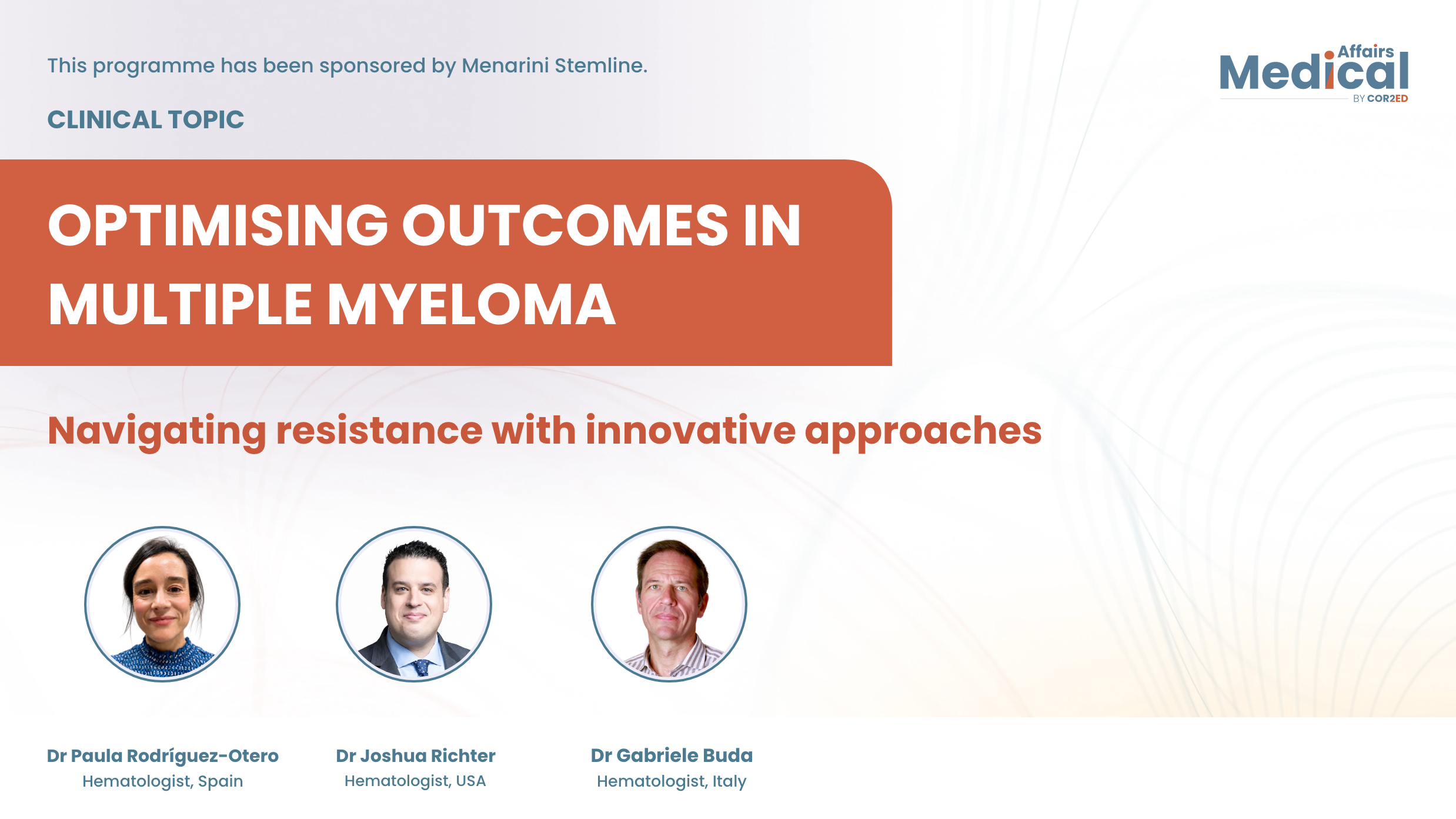


In a recent interactive webinar, renowned experts Prof. Aurore Perrot, Prof. Hermann Einsele, Assoc. Prof. Karthik Ramasamy and Assoc. Prof. Joshua Richter discussed the challenges of optimising treatment for early relapsed/refractory multiple myeloma (RRMM), exploring current treatment options and sharing insights from clinical practice.


Watch the on-demand video to hear the medical experts discuss:

  • Current treatments for early RRMM: Linking mechanism of action to efficacy 
  • Best practices in combining and sequencing therapies for optimal outcomes in early RRMM 
  • Insights from clinical practice on how to manage tolerability and safety 


The event concluded with speakers and participants engaging in patient case study discussion and Q&A to address pressing questions. 


Clinical takeaways

  • Myeloma is a continually evolving field with modern day induction regimens yielding near 100% response rates in the front-line setting with typically durable remissions
  • This has been achieved through triplets and quadruplets comprised of the 3 classic MOAs:  IMiD, PI, mAb
  • In the relapsed/refractory space it is important to embrace novel MOAs/targets to optimally manage recurrent disease: XPO1, BCMA, GPRC5d
  • T-cell health is an important long-term consideration for patients to maximise efficacy of T-cell redirection therapy
  • Treatments that are T-cell-sparing, such as XPO1 inhibitors and IMiDs, have the potential to preserve T-cell health

Educational objectives

To educate learners on how to incorporate the latest scientific and clinical insights on the treatment of early RRMM into clinical practice:

  • Knowing the MoA of novel therapies and how this translates into efficacy
  • Learning from best practices on treatment sequencing, treatment combinations and dosing
  • Knowing the safety profiles of novel drugs and understanding the best strategies to manage side effects

Karthik Ramasamy is a Consultant Haematologist at Oxford University Hospitals NHS Trust and Associate Professor of Haematology, Radcliffe Department of Medicine, Oxford UK. Dr Ramasamy is the Director of the Oxford Myeloma Translational Research Centre, and a Lead Clinician for myeloma and other plasma cell dyscrasias at the Thames Valley Cancer Alliance Group. He is the Divisional Lead for Cancer research for National Institute for Health Research, Clinical Research Network Thames Valley and South Midlands, UK. He is an executive member of the UK Myeloma Forum and is an active member of UK Myeloma Research Alliance. Karthik serves on the Myeloma UK Board, a patient charity exclusively dealing with myeloma advocacy and research. Dr Ramasamy completed his haematology training in London. Following this, he completed three years as a clinical research fellow working on bone marrow microenvironment in myeloma at King’s College London. Dr Ramasamy is a Chief Investigator of myeloma studies and his translational research interests are early diagnosis of myeloma, myeloma renal, bone disease and myeloma drug resistance mechanisms. Karthik has published over 50 papers and authored textbooks/ chapters on myeloma

Prof. Karthik Ramasamy has received financial support/sponsorship for research support, consultation, or speaker fees from the following companies:

Amgen, Adaptive, BMS, Biotech, GSK, Janssen, Karyopharm, Oncopeptides, Pfizer and Takeda. 

Joshua Richter, M.D., is an Associate Professor in the Myeloma Division at the Tisch Cancer Institute at the Icahn School of Medicine at Mount Sinai and the Director of Myeloma at the Blavatnik Family Chelsea Medical Center at Mount Sinai.  He completed undergraduate work at Johns Hopkins University and subsequently went on to medical school at New York Medical College. He completed residency at St. Vincent’s Hospital – New York Medical College.  Dr Richter completed his hematology/oncology fellowship at the Yale Cancer Center.  After completing fellowship he worked in the myeloma division at the John Theurer Cancer Center at Hackensack University Medical.  In 2018 he joined the Myeloma Division at Mount Sinai Hospital.   Dr Richter has been published in numerous oncology journals including NEJM, Blood, and the Journal of Clinical Oncology.   He has an interest in immunotherapy, multi-functional antibodies and precision medicine.

Dr Joshua Richter has received financial support/sponsorship for research support, consultation, or speaker fees from the following companies:

Adaptive Biotechnologies, AstraZeneca, BMS, Celgene, Janssen, Karyopharm, Oncopeptides, Secura Bio, Sanofi and X4 Pharmaceuticals. 

In a recent interactive webinar, renowned experts Prof. Aurore Perrot, Prof. Hermann Einsele, Assoc. Prof. Karthik Ramasamy and Assoc. Prof. Joshua Richter discussed the challenges of optimising treatment for early relapsed/refractory multiple myeloma (RRMM), exploring current treatment options and sharing insights from clinical practice.


Watch the on-demand video to hear the medical experts discuss:

  • Current treatments for early RRMM: Linking mechanism of action to efficacy 
  • Best practices in combining and sequencing therapies for optimal outcomes in early RRMM 
  • Insights from clinical practice on how to manage tolerability and safety 


The event concluded with speakers and participants engaging in patient case study discussion and Q&A to address pressing questions. 


Not got time to watch the full video? Go to the video highlights: Highlights- Optimising the management of multiple myeloma in the early relapsed refractory setting.


Clinical takeaways

  • Myeloma is a continually evolving field with modern day induction regimens yielding near 100% response rates in the front-line setting with typically durable remissions
  • This has been achieved through triplets and quadruplets comprised of the 3 classic MOAs:  IMiD, PI, mAb
  • In the relapsed/refractory space it is important to embrace novel MOAs/targets to optimally manage recurrent disease: XPO1, BCMA, GPRC5d
  • T-cell health is an important long-term consideration for patients to maximise efficacy of T-cell redirection therapy
  • Treatments that are T-cell-sparing, such as XPO1 inhibitors and IMiDs, have the potential to preserve T-cell health

Educational objectives

To educate learners on how to incorporate the latest scientific and clinical insights on the treatment of early RRMM into clinical practice:

  • Knowing the MoA of novel therapies and how this translates into efficacy
  • Learning from best practices on treatment sequencing, treatment combinations and dosing
  • Knowing the safety profiles of novel drugs and understanding the best strategies to manage side effects

Karthik Ramasamy is a Consultant Haematologist at Oxford University Hospitals NHS Trust and Associate Professor of Haematology, Radcliffe Department of Medicine, Oxford UK. Dr Ramasamy is the Director of the Oxford Myeloma Translational Research Centre, and a Lead Clinician for myeloma and other plasma cell dyscrasias at the Thames Valley Cancer Alliance Group. He is the Divisional Lead for Cancer research for National Institute for Health Research, Clinical Research Network Thames Valley and South Midlands, UK. He is an executive member of the UK Myeloma Forum and is an active member of UK Myeloma Research Alliance. Karthik serves on the Myeloma UK Board, a patient charity exclusively dealing with myeloma advocacy and research. Dr Ramasamy completed his haematology training in London. Following this, he completed three years as a clinical research fellow working on bone marrow microenvironment in myeloma at King’s College London. Dr Ramasamy is a Chief Investigator of myeloma studies and his translational research interests are early diagnosis of myeloma, myeloma renal, bone disease and myeloma drug resistance mechanisms. Karthik has published over 50 papers and authored textbooks/ chapters on myeloma

Prof. Karthik Ramasamy has received financial support/sponsorship for research support, consultation, or speaker fees from the following companies:

Amgen, Adaptive, BMS, Biotech, GSK, Janssen, Karyopharm, Oncopeptides, Pfizer and Takeda. 

Joshua Richter, M.D., is an Associate Professor in the Myeloma Division at the Tisch Cancer Institute at the Icahn School of Medicine at Mount Sinai and the Director of Myeloma at the Blavatnik Family Chelsea Medical Center at Mount Sinai.  He completed undergraduate work at Johns Hopkins University and subsequently went on to medical school at New York Medical College. He completed residency at St. Vincent’s Hospital – New York Medical College.  Dr Richter completed his hematology/oncology fellowship at the Yale Cancer Center.  After completing fellowship he worked in the myeloma division at the John Theurer Cancer Center at Hackensack University Medical.  In 2018 he joined the Myeloma Division at Mount Sinai Hospital.   Dr Richter has been published in numerous oncology journals including NEJM, Blood, and the Journal of Clinical Oncology.   He has an interest in immunotherapy, multi-functional antibodies and precision medicine.

Dr Joshua Richter has received financial support/sponsorship for research support, consultation, or speaker fees from the following companies:

Adaptive Biotechnologies, AstraZeneca, BMS, Celgene, Janssen, Karyopharm, Oncopeptides, Secura Bio, Sanofi and X4 Pharmaceuticals. 

Programme summary
Take the e-learning now
Share this programme
This educational programme is supported by an Independent Educational Grant from Menarini Stemline Oncology.
Supporter Acknowledgement
This educational programme is supported by an Independent Educational Grant from Menarini Stemline Oncology.
I agree that this educational programme:

Was valuable to me

1/4
Brought to you by
LYMPHOMA & MYELOMA CONNECT

LYMPHOMA & MYELOMA CONNECT is an initiative of COR2ED, supported by Independent Educational Grants from Bayer, Karyopharm Therapeutics and Menarini Stemline Oncology.

Meet the experts Independent IME approved
Programme summary
Take the e-learning now
Share this programme
This educational programme is supported by an Independent Educational Grant from Menarini Stemline Oncology.
Supporter Acknowledgement
This educational programme is supported by an Independent Educational Grant from Menarini Stemline Oncology.
I agree that this educational programme:

Was valuable to me

1/4
Brought to you by
LYMPHOMA & MYELOMA CONNECT

LYMPHOMA & MYELOMA CONNECT is an initiative of COR2ED, supported by Independent Educational Grants from Bayer, Karyopharm Therapeutics and Menarini Stemline Oncology.

Meet the experts Independent IME approved

Other programmes of interest

eks
EKS / On-demand webinar
Oncology 
Multiple Myeloma: Is it time to rethink how we sequence treatments?

On-demand materials from an Experts Knowledge Share event

Experts
Prof. Karthik Ramasamy, Dr Joshua Richter, Dr Faisal Basheer, Dr Andrew Charlton
  • download Downloadable
    Resources
  • clock 80 MIN
  • calendar Mar 2026

This programme has been sponsored by Menarini Stemline and is intended for HCPs in the UK only    MAT-GB-SEL-00774
conference-update Conference update

Episode

2

of 2

episode
Oncology Rare diseases Endocrinology 
Actualités du Congrès l’ENETS 2026

Points de vue d’experts sur les dernières données concernant le cancer neuroendocrinien

Experts
Prof. Louis de Mestier, Prof. Timon Vandamme, Dr Alice Durand
  • clock 5 MIN
  • calendar Mar 2026
  • Non-accredited Independent Medical Education

Cette vidéo est soutenue par une subvention indépendante à visée éducative d’Ipsen.  Les contenus publiés sur ce site internet sont sous la responsabilité de leurs auteurs. Certaines données scientifiques publiées sur ce site sont susceptibles de ne pas être validées par la commission d’Autorisation de Mise sur le Marché, et ne doivent pas être mises en pratique. Elles doivent être lues et comprises avec le plus grand discernement et sont données dans leur cadre de la diffusion de l’information sur l’état actuel de la recherche auprès de la communauté scientifique internationale  
conference-update Conference update

Episode

1

of 2

episode
Oncology Rare diseases Endocrinology 
Update from ENETS 2026

Experts share their views on latest data in neuroendocrine cancer

Experts
Prof. Louis de Mestier, Prof. Timon Vandamme, Dr Alice Durand
  • clock 5 MIN
  • calendar Mar 2026
  • Non-accredited Independent Medical Education

This educational programme is supported by an Independent Educational Grant from Ipsen. The content published on this website is under the responsibility of its authors. Some scientific data published on this website may not have been validated by the relevant Marketing Authorisation Committees and should not be put into practice. It should be read and understood with the utmost discernment and is provided for the purpose of disseminating information on the current state of research to the international scientific community.
patient-support Patient Support
Oncology Hemato-oncology Pediatrics 
Personalised treatment in childhood cancer: A journey through NTRK fusion testing

Experts
Linet Menachery
Endorsed by
NTRKers ICAN international cancer advocacy network Biomarker Collaborative
  • clock 4 MIN
  • calendar Mar 2026
  • Non-accredited Independent Medical Education

Educational programme supported by an Independent Educational Grant from Bayer.
conference-update Conference update
Oncology 
Update from ESGO 2026 – PYNNACLE Phase 2 study: Interim results from the ovarian cancer cohort

Clinical insights and expert discussion

Experts
Prof. Domenica Lorusso, Prof. Jean-Sebastien Frenel
  • download Downloadable
    Resources
  • clock 5 MIN
  • calendar Mar 2026

This programme has been sponsored by PMV Pharma and is intended for HCPs only.