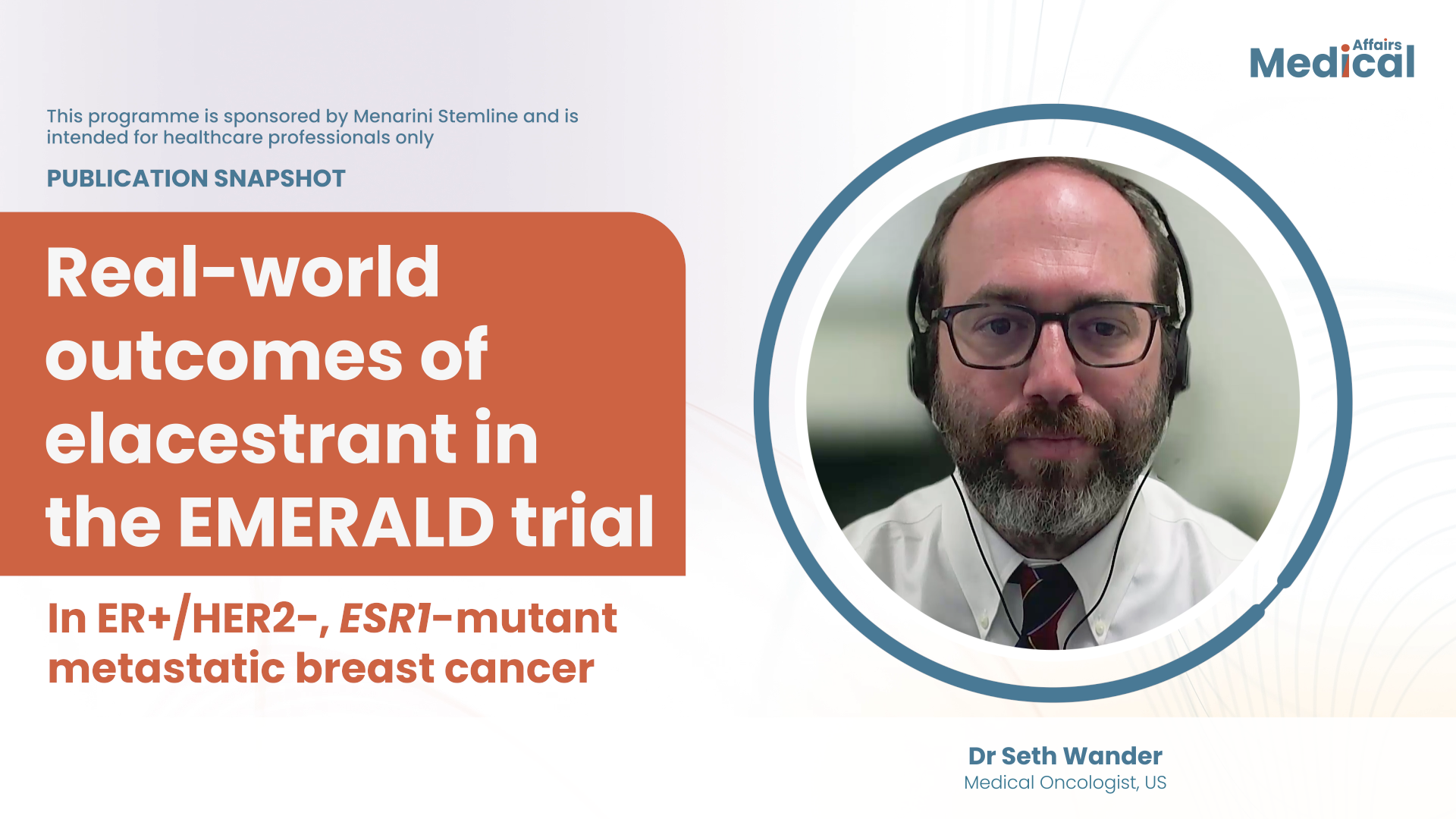
In this animated video, Dr Javier Cortés sheds light on the phase 3 EMERALD trial subgroup analyses and explores how these findings inform clinical decision-making in the 2nd line setting, following ET + CDK4/6i therapy, for patients with ESR1-mutated tumors.

Key topics include: 

  • Identifying tumors that remain endocrine-sensitive despite acquired resistance to previous ET 
  • Discussion of subgroup analysis results and their implications for clinical practice
  • A review of alternative second-line treatment options 


Clinical takeaways

  • Elacestrant provides clinically meaningful improvements in PFS for patients with ER+/HER2- mBC who received at least 12 months of ET+CDK4/6i in 1st line and whose tumors harbor ESR1-mut  
  • The PFS benefit associated with elacestrant was consistent across clinically relevant subgroups including tumors harboring coexisting ESR1 and PIK3CA-mut, indicating that disease progression after ET + CDK4/6i in this subgroup may remain ER-driven. 
  • Safety analyses demonstrated that elacestrant had a manageable safety profile similar to other ETs and without evidence of some of the toxicities associated with other drug classes, such as CDK4/6i and PI3K/AKT/mTOR inhibitors.
  • ESR1-mut testing should be done at 1st line progression via liquid biopsy due to disease subclonality; if negative, repeat at each progression. Archival tissue should not be used for testing due to the acquired nature of ESR1-mut  

Head of the International Breast Cancer Centre (IBCC) in Barcelona, founding partner of Medica Scientia innovation Research (MedSIR), a company involved in the clinical development of clinical trials. Member of the Scientific Committee of the ESMO and EBCC.

Prof. Javier Cortés has received financial support/sponsorship for research support, consultation, or speaker fees from the following companies:

Roche , AstraZeneca, Seattle Genetics, Daiichi Sankyo, Lilly, Merck Sharp & Dohme, Leuko, Bioasis, Clovis Oncology, Boehringer Ingelheim, Ellipses, Hibercell, BioInvent, Gemoab, Gilead, Menarini, Zymeworks, Reveal Genomics, Scorpion Therapeutics, Expres2ion Biotechnologies, Jazz Pharmaceuticals, Abbvie, BridgeBio, Biontech, Biocon, Circle Pharma, Delcath Systems, Roche, Novartis, Eisai, Pfizer, Lilly, Merck Sharp & Dohme, Daiichi Sankyo, Astrazeneca, Gilead, Stemline Therapeutics.

In this animated video, Dr Javier Cortés sheds light on the phase 3 EMERALD trial subgroup analyses and explores how these findings inform clinical decision-making in the 2nd line setting, following ET + CDK4/6i therapy, for patients with ESR1-mutated tumors.

Key topics include: 

  • Identifying tumors that remain endocrine-sensitive despite acquired resistance to previous ET 
  • Discussion of subgroup analysis results and their implications for clinical practice
  • A review of alternative second-line treatment options 


Clinical takeaways

  • Elacestrant provides clinically meaningful improvements in PFS for patients with ER+/HER2- mBC who received at least 12 months of ET+CDK4/6i in 1st line and whose tumors harbor ESR1-mut  
  • The PFS benefit associated with elacestrant was consistent across clinically relevant subgroups including tumors harboring coexisting ESR1 and PIK3CA-mut, indicating that disease progression after ET + CDK4/6i in this subgroup may remain ER-driven. 
  • Safety analyses demonstrated that elacestrant had a manageable safety profile similar to other ETs and without evidence of some of the toxicities associated with other drug classes, such as CDK4/6i and PI3K/AKT/mTOR inhibitors.
  • ESR1-mut testing should be done at 1st line progression via liquid biopsy due to disease subclonality; if negative, repeat at each progression. Archival tissue should not be used for testing due to the acquired nature of ESR1-mut  

Head of the International Breast Cancer Centre (IBCC) in Barcelona, founding partner of Medica Scientia innovation Research (MedSIR), a company involved in the clinical development of clinical trials. Member of the Scientific Committee of the ESMO and EBCC.

Prof. Javier Cortés has received financial support/sponsorship for research support, consultation, or speaker fees from the following companies:

Roche , AstraZeneca, Seattle Genetics, Daiichi Sankyo, Lilly, Merck Sharp & Dohme, Leuko, Bioasis, Clovis Oncology, Boehringer Ingelheim, Ellipses, Hibercell, BioInvent, Gemoab, Gilead, Menarini, Zymeworks, Reveal Genomics, Scorpion Therapeutics, Expres2ion Biotechnologies, Jazz Pharmaceuticals, Abbvie, BridgeBio, Biontech, Biocon, Circle Pharma, Delcath Systems, Roche, Novartis, Eisai, Pfizer, Lilly, Merck Sharp & Dohme, Daiichi Sankyo, Astrazeneca, Gilead, Stemline Therapeutics.

Programme summary
Watch the video now
Share this programme
This programme has been sponsored by Menarini Stemline and is intended for healthcare professionals only.
Supporter Acknowledgement
This programme has been sponsored by Menarini Stemline and is intended for healthcare professionals only.
I agree that this programme:

Was valuable to me

1/3
Programme summary
Share this programme
Brought to you by COR2ED Medical Affairs in collaboration with This programme has been sponsored by Menarini Stemline and is intended for healthcare professionals only.
Supporter Acknowledgement
Brought to you by COR2ED Medical Affairs in collaboration with This programme has been sponsored by Menarini Stemline and is intended for healthcare professionals only.
I agree that this programme:

Was valuable to me

1/3

Other programmes of interest

symposium Masterclass / Symposium
Oncology 
ER+/HER2- metastatic breast cancer: ESMO Breast Cancer 2026 Satellite Symposium highlights

Experts discuss 2nd line+ treatment strategies in endocrine therapy-eligible patients

Experts
Prof. Nadia Harbeck, Dr Tiffany Traina, Prof. Frederik Marmé
  • download Downloadable
    Resources
  • clock 6 MIN
  • calendar Jun 2026

This programme has been sponsored by Menarini Stemline and is intended for HCPs only.
conference-update Conference update
Oncology 
Highlights from ASCO 2026

Expert insights on the latest data

Experts
Dr Herbert Loong, Dr Isabel Preeshagul, Prof. Mark Socinski, Prof. Evan Yu, Prof. Hans Prenen, Dr Paolo Tarantino
  • download Downloadable
    Resources
  • clock 4 MIN
  • calendar Jun 2026
  • Non-accredited Independent Medical Education

Infographic / Flashcard
Oncology Rare diseases 
EP-NEC at a glance

Understanding EP-NEC, emerging treatments, and patient care strategies

Experts
Meredith Cummins
  • download Downloadable
    Resources
  • clock 1 MIN
  • calendar May 2026

This programme has been sponsored by Boehringer Ingelheim
eks
EKS / On-demand webinar
Oncology 
The evolving TROP2-directed ADC landscape in metastatic NSCLC

Strategies to optimise the treatment experience

Experts
Prof. Nicolas Girard, Dr Louise Lim, Dr Jacob Sands, Mrs Stephanie McDonald
Endorsed by
Exon20group Biomarker Collaborative ICAN international cancer advocacy network
  • download Downloadable
    Resources
  • clock 58 MIN
  • calendar May 2026
  • Non-accredited Independent Medical Education

Educational programme supported by an Independent Educational Grant from AstraZeneca
conference-update Conference update
Oncology 
Oncogene-addicted NSCLC highlights from ELCC 2026

Expert insights on the latest NSCLC data

Experts
Prof. Nicolas Girard
Endorsed by
ICAN international cancer advocacy network Biomarker Collaborative Exon20group
ISLB Lung Cancer Europe
  • download Downloadable
    Resources
  • clock 4 MIN
  • calendar Mar 2026
  • Non-accredited Independent Medical Education

Educational programme supported by an Independent Educational Grant from Bayer.
podcast Video podcast
Oncology 
Pre-analytical phase challenges and biomarker testing in HER2+ metastatic breast cancer

Experts
Dr Carlos Barrios, Prof. Gary Tse, Oncology Brothers (Moderators)
Endorsed by
Biomarker Collaborative
  • download Downloadable
    Resources
  • clock 23 MIN
  • calendar Mar 2026
  • Non-accredited Independent Medical Education

Educational programme supported by an Independent Educational Grant from Daiichi Sankyo