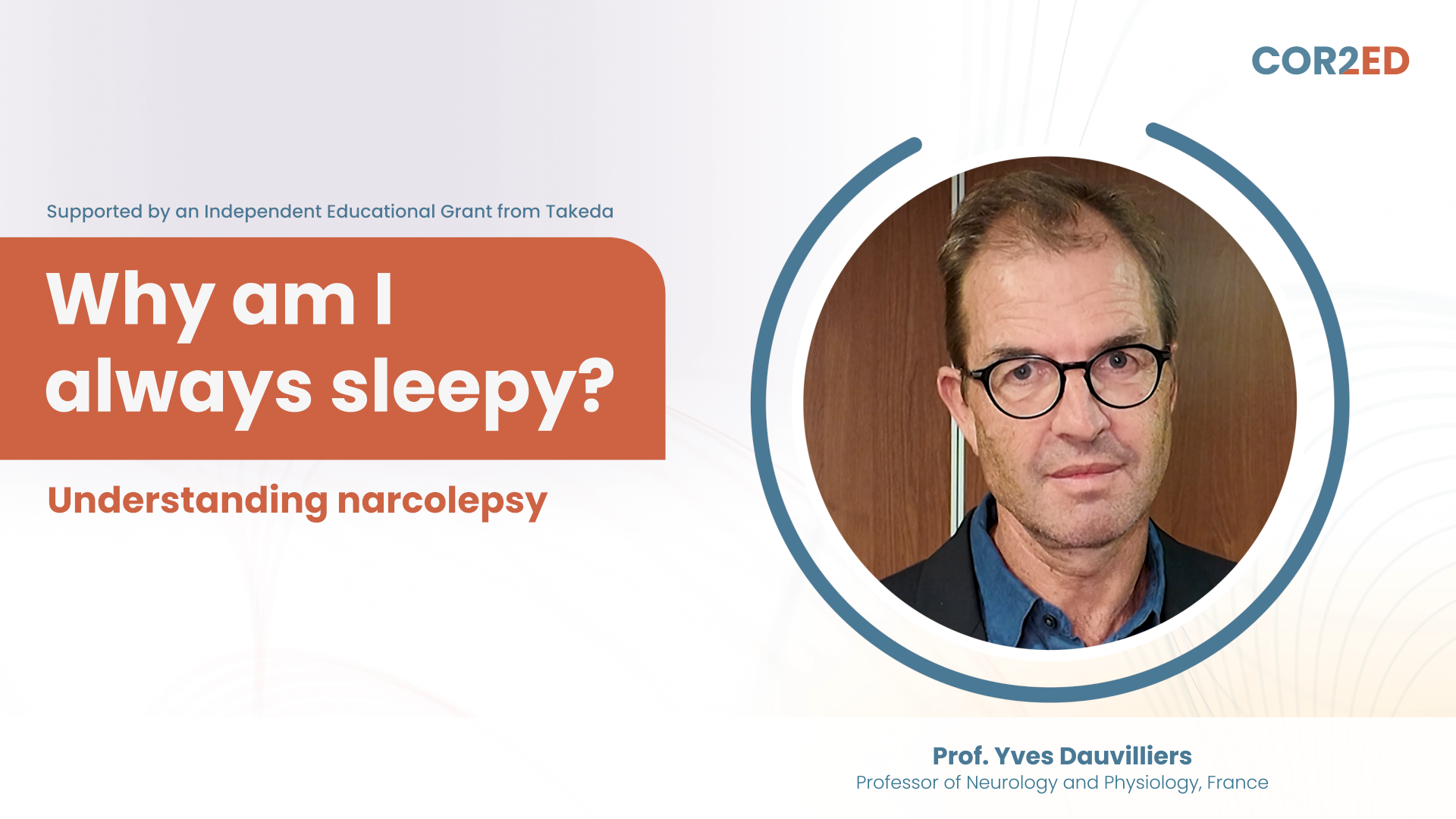
In this video, Prof. Yves Dauvilliers explores narcolepsy type 1 through a practical, case-based lens, focusing on the key role of orexin deficiency in driving symptoms. He highlights the unmet needs in current treatment approaches, including ongoing residual symptoms and reliance on polypharmacy, and looks ahead to emerging orexin-targeted therapies that may redefine disease management and improve outcomes for patients.


Clinical takeaways

  • Narcolepsy type 1 is characterised by selective loss of hypothalamic orexin/hypocretin neurons, resulting in reduced excitatory drive to monoaminergic and cortical wake-promoting networks. This destabilises the sleep–wake boundary, leading to excessive daytime sleepiness and dysregulated REM sleep, including cataplexy  
  • Patients continue to experience residual disease burden despite guideline-recommended therapy, highlighting the need for novel therapeutic approaches. Selective hypocretin receptor agonists are a promising new class designed to directly restore orexin signalling 
  • Oveporexton phase 3 trials (FirstLight and RadiantLight) demonstrated significant improvement in mean sleep latency on the Maintenance of Wakefulness Test (MWT) by week 12, with no treatment-related serious treatment-emergent adverse events (TEAEs). The most common adverse events were insomnia and urinary frequency or urgency, generally mild to moderate, early-onset and transient 
  • Alixorexton phase 2 data (Vibrance-1) showed achievement of normative wakefulness across doses (4, 6 and 8 mg), with no serious TEAEs. Adverse events were mostly early-onset, mild to moderate and included pollakiuria, insomnia and salivary hypersecretion 

Understand the pathophysiology and impact of narcolepsy type 1 

  • Explain the role of orexin deficiency and its effect on excessive daytime sleepiness (EDS), cataplexy, and co-morbidities 


Evaluate current and emerging treatment strategies 

  • Compare the mechanisms, efficacy, and safety of approved narcolepsy treatments 
  • Assess the clinical impact of emerging therapies aiming to address the underlying orexin deficiency 

Prof. Yves Dauvilliers is a director of the Sleep Disorders Centre, Department of Neurology, Gui de Chauliac Hospital, Montpellier since 2005, coordinator of the National Reference Network for Orphan Diseases: Narcolepsy and Idiopathic Hypersomnia.
He became a specialist in Neurology, Montpellier University, 1995, obtained univ. diploma, “Clinical Neurophysiology”, Montpellier, 1997, “Wake and Sleep”, France, 1998, wrote medical thesis, “Genetic and familial aspects of narcolepsy”, Montpellier, 2000 and PhD thesis in Neurosciences, “Neurobiology and Genetics of Narcolepsy”, Montpellier, 2004. He became a Professor of Neurology-Physiology in 2008. He obtained post doc training at Centre d’études du sommeil, Hopital du Sacré-Coeur, Montreal, Canada, 2006 and -HUG Belle Idée, Neuropsychiatric Division, Chene-Bourg, Switzerland, 1999, 2001
He serves as a reviewer for Lancet, NEJM, Brain, Annals of Neurology, Neurology, Journal of Neurology, Neuropsychiatry and Neurosurgery, Sleep, Journal of Sleep Research, Sleep Medicine, Brain, Archives of Internal Medicine, Editor in Chief for the journal: Frontiers in Neurology, Section “Sleep and Chronobiology”. He is a member of the Editorial Board for the journal: Sleep Medecine, SLEEP, Sleep Medicine Review and behavioural neurology.
He is a member of Scientific Committee of the EU NN, ESRS, SFRMS, AASM, Co-chair of the Centre of Excellence in neurodegeneration, Montpellier, Coordinator Axis Central Hypersomnia – GDR Sleep, Vice-President of EU RLS Study Group.
The main domains of his research are studies in the diagnosis, epidemiology, pathophysiology and therapy of sleep disorders related to neurological disorders including narcolepsy, hypersomnias, parasomnia, insomnia, Parkinson, Alzheimer and RLS.
Prof. Dauvilliers is a author or coauthor of 459 papers published in international and national peer-reviewed journals (including Lancet, Lancet Neurol, Science, Nature Genetic), h index: 67 WOS.

Prof. Yves Dauvilliers has received financial support/sponsorship for research support, consultation, or speaker fees from the following companies:

Jazz, Idorsia, Takeda, Alkermes, Centessa, Pharmanovia, Avadel and Bioprojet.

In this video, Prof. Yves Dauvilliers explores narcolepsy type 1 through a practical, case-based lens, focusing on the key role of orexin deficiency in driving symptoms. He highlights the unmet needs in current treatment approaches, including ongoing residual symptoms and reliance on polypharmacy, and looks ahead to emerging orexin-targeted therapies that may redefine disease management and improve outcomes for patients.


Clinical takeaways

  • Narcolepsy type 1 is characterised by selective loss of hypothalamic orexin/hypocretin neurons, resulting in reduced excitatory drive to monoaminergic and cortical wake-promoting networks. This destabilises the sleep–wake boundary, leading to excessive daytime sleepiness and dysregulated REM sleep, including cataplexy  
  • Patients continue to experience residual disease burden despite guideline-recommended therapy, highlighting the need for novel therapeutic approaches. Selective hypocretin receptor agonists are a promising new class designed to directly restore orexin signalling 
  • Oveporexton phase 3 trials (FirstLight and RadiantLight) demonstrated significant improvement in mean sleep latency on the Maintenance of Wakefulness Test (MWT) by week 12, with no treatment-related serious treatment-emergent adverse events (TEAEs). The most common adverse events were insomnia and urinary frequency or urgency, generally mild to moderate, early-onset and transient 
  • Alixorexton phase 2 data (Vibrance-1) showed achievement of normative wakefulness across doses (4, 6 and 8 mg), with no serious TEAEs. Adverse events were mostly early-onset, mild to moderate and included pollakiuria, insomnia and salivary hypersecretion 

Understand the pathophysiology and impact of narcolepsy type 1 

  • Explain the role of orexin deficiency and its effect on excessive daytime sleepiness (EDS), cataplexy, and co-morbidities 


Evaluate current and emerging treatment strategies 

  • Compare the mechanisms, efficacy, and safety of approved narcolepsy treatments 
  • Assess the clinical impact of emerging therapies aiming to address the underlying orexin deficiency 

Prof. Yves Dauvilliers is a director of the Sleep Disorders Centre, Department of Neurology, Gui de Chauliac Hospital, Montpellier since 2005, coordinator of the National Reference Network for Orphan Diseases: Narcolepsy and Idiopathic Hypersomnia.
He became a specialist in Neurology, Montpellier University, 1995, obtained univ. diploma, “Clinical Neurophysiology”, Montpellier, 1997, “Wake and Sleep”, France, 1998, wrote medical thesis, “Genetic and familial aspects of narcolepsy”, Montpellier, 2000 and PhD thesis in Neurosciences, “Neurobiology and Genetics of Narcolepsy”, Montpellier, 2004. He became a Professor of Neurology-Physiology in 2008. He obtained post doc training at Centre d’études du sommeil, Hopital du Sacré-Coeur, Montreal, Canada, 2006 and -HUG Belle Idée, Neuropsychiatric Division, Chene-Bourg, Switzerland, 1999, 2001
He serves as a reviewer for Lancet, NEJM, Brain, Annals of Neurology, Neurology, Journal of Neurology, Neuropsychiatry and Neurosurgery, Sleep, Journal of Sleep Research, Sleep Medicine, Brain, Archives of Internal Medicine, Editor in Chief for the journal: Frontiers in Neurology, Section “Sleep and Chronobiology”. He is a member of the Editorial Board for the journal: Sleep Medecine, SLEEP, Sleep Medicine Review and behavioural neurology.
He is a member of Scientific Committee of the EU NN, ESRS, SFRMS, AASM, Co-chair of the Centre of Excellence in neurodegeneration, Montpellier, Coordinator Axis Central Hypersomnia – GDR Sleep, Vice-President of EU RLS Study Group.
The main domains of his research are studies in the diagnosis, epidemiology, pathophysiology and therapy of sleep disorders related to neurological disorders including narcolepsy, hypersomnias, parasomnia, insomnia, Parkinson, Alzheimer and RLS.
Prof. Dauvilliers is a author or coauthor of 459 papers published in international and national peer-reviewed journals (including Lancet, Lancet Neurol, Science, Nature Genetic), h index: 67 WOS.

Prof. Yves Dauvilliers has received financial support/sponsorship for research support, consultation, or speaker fees from the following companies:

Jazz, Idorsia, Takeda, Alkermes, Centessa, Pharmanovia, Avadel and Bioprojet.

Programme summary
Watch the video now
Share this programme
This educational programme is supported by an Independent Educational Grant from Takeda
Supporter Acknowledgement
This educational programme is supported by an Independent Educational Grant from Takeda
Endorsement
I agree that this educational programme:

Was valuable to me

1/4
Brought to you by
SLEEP CONNECT

SLEEP CONNECT is an initiative of COR2ED, supported by an Independent Educational Grant from Takeda.

Meet the experts Independent IME approved
Programme summary
Share this programme
This educational programme is supported by an Independent Educational Grant from Takeda
Supporter Acknowledgement
This educational programme is supported by an Independent Educational Grant from Takeda
Endorsement
I agree that this educational programme:

Was valuable to me

1/4
Brought to you by
SLEEP CONNECT

SLEEP CONNECT is an initiative of COR2ED, supported by an Independent Educational Grant from Takeda.

Meet the experts Independent IME approved

Other programmes of interest

conference-update Conference update

Episode

2

of 2

episode
Oncology Rare diseases Endocrinology 
Actualités du Congrès l’ENETS 2026

Points de vue d’experts sur les dernières données concernant le cancer neuroendocrinien

Experts
Prof. Louis de Mestier, Prof. Timon Vandamme, Dr Alice Durand
  • clock 5 MIN
  • calendar Mar 2026
  • Non-accredited Independent Medical Education

Cette vidéo est soutenue par une subvention indépendante à visée éducative d’Ipsen.  Les contenus publiés sur ce site internet sont sous la responsabilité de leurs auteurs. Certaines données scientifiques publiées sur ce site sont susceptibles de ne pas être validées par la commission d’Autorisation de Mise sur le Marché, et ne doivent pas être mises en pratique. Elles doivent être lues et comprises avec le plus grand discernement et sont données dans leur cadre de la diffusion de l’information sur l’état actuel de la recherche auprès de la communauté scientifique internationale  
conference-update Conference update

Episode

1

of 2

episode
Oncology Rare diseases Endocrinology 
Update from ENETS 2026

Experts share their views on latest data in neuroendocrine cancer

Experts
Prof. Louis de Mestier, Prof. Timon Vandamme, Dr Alice Durand
  • clock 5 MIN
  • calendar Mar 2026
  • Non-accredited Independent Medical Education

This educational programme is supported by an Independent Educational Grant from Ipsen. The content published on this website is under the responsibility of its authors. Some scientific data published on this website may not have been validated by the relevant Marketing Authorisation Committees and should not be put into practice. It should be read and understood with the utmost discernment and is provided for the purpose of disseminating information on the current state of research to the international scientific community.
patient-support Patient Support
Rare diseases 
Understanding narcolepsy

Persistent sleepiness: when to look closer

Experts
Prof. Yves Dauvilliers
Endorsed by
EU-NN ANC
eNAP
  • clock 2 MIN
  • calendar Jan 2026
  • Non-accredited Independent Medical Education

Educational programme supported by an Independent Educational Grant from Takeda
patient-support Patient Support

Episode

2

of 2

episode
Oncology Endocrinology Rare diseases 
Thriving beyond an EP-NEC diagnosis

Perspectives on treatment and care 

Experts
Jessica Thomas
Endorsed by
NET-Research-Foundation Minkhas mission
  • clock 4 MIN
  • calendar Dec 2025
  • Non-accredited Independent Medical Education

Educational programme supported by an Independent Educational Grant from Boehringer Ingelheim 
patient-support Patient Support

Episode

1

of 2

episode
Oncology Endocrinology Rare diseases 
Navigating extrapulmonary neuroendocrine carcinoma (EP-NEC)

Insights for patients and care partners 

Experts
Meredith Cummins
Endorsed by
INCA
NeuroEndocrine Cancer Australia Neuroendocrine Cancer Foundation NET-Research-Foundation
Neuroendocrine Cancer UK Minkhas mission
  • clock 5 MIN
  • calendar Dec 2025
  • Non-accredited Independent Medical Education

Educational programme supported by an Independent Educational Grant from Boehringer Ingelheim 
podcast Video podcast
Oncology Endocrinology Rare diseases 
Understanding EP-NEC: Through diagnosis, treatment, and support

A medical oncologist and a patient advocate share their perspectives

Experts
Dr Aman Chauhan, Susan Meckler-Plummer, RN
Endorsed by
Minkhas mission Neuroendocrine Cancer UK Neuroendocrine Cancer Foundation
NET-Research-Foundation
  • download Downloadable
    Resources
  • clock 27 MIN
  • calendar Nov 2025
  • Non-accredited Independent Medical Education

Educational programme supported by an Independent Educational Grant from Boehringer Ingelheim