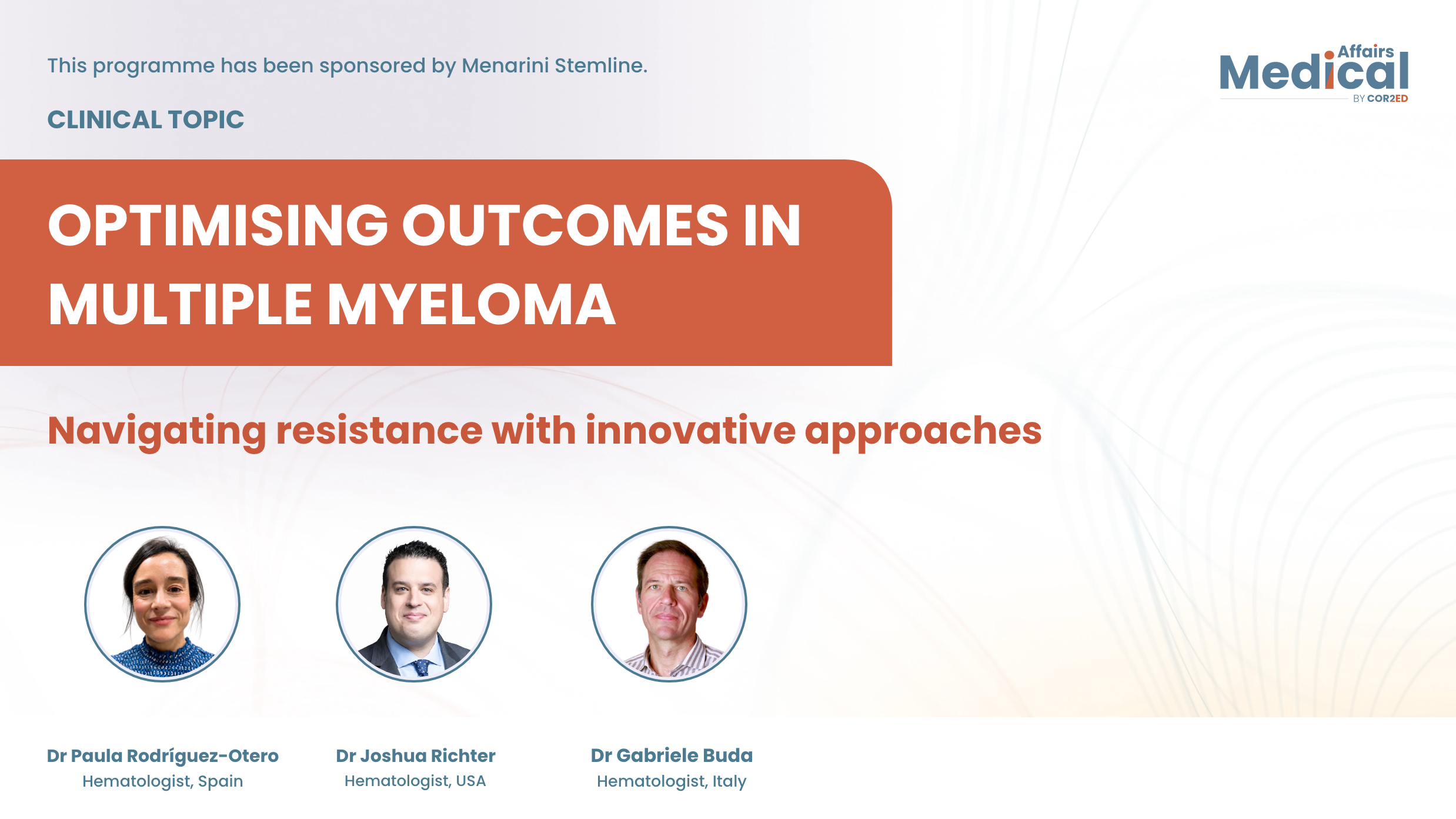
In this video, Prof. María-Victoria Mateos examines the strategic role of selinexor in the evolving relapsed/refractory multiple myeloma (RRMM) landscape, focusing on how its unique XPO1 inhibition addresses the challenge of early refractoriness to lenalidomide and anti-CD38 therapies, as well as its place in sequencing T-cell-directed therapies.


She explores the clinical benefits of this antigen-independent mechanism, highlighting its efficacy in difficult-to-treat subgroups and its ability to preserve T-cell fitness for future treatment lines.


Key insights include:


  • Clinical efficacy: The role of selinexor in 2nd line and 3rd line settings for patients with high unmet needs, particularly Len-refractory and anti-CD38-refractory patients
  • Strategic sequencing: How selinexor-based regimens (SVd) can help optimise the use of subsequent BCMA-targeted therapies
  • Practical management: Expert guidance on managing a predictable safety profile as well as effective dosing strategies (80–100 mg) to ensure treatment adherence


Clinical takeaways

  • Selinexor addresses the unmet needs of difficult-to-treat RRMM patients by providing a unique therapeutic option in early relapse settings
  • Selinexor’s non-BCMA-dependent MoA reserves BCMA-targeted therapies for later lines of treatment, while its immunomodulatory effects potentially improve their efficacy
  • Selinexor has a predictable safety profile and manageable adverse events (AEs)
  • Balance efficacy and tolerability in the SVd regimen with a selinexor starting dose of 80 to 100 mg
  • Understand the challenges associated with the evolving landscape of RRMM
  • Describe the MoA of XPO1 inhibition, its efficacy in different subgroups, as well as the importance of sequencing with BCMA-targeted therapies
  • Understand selinexor safety and dosing

Dr María-Victoria Mateos, MD, PhD, is Consultant Physician in the Haematology Department and Associate Professor of Medicine at the University of Salamanca, Spain.


She is the director of the Myeloma Program and coordinates the Clinical Trials Unit in Salamanca’s University Hospital Haematology Department. She serves as coordinator of GEM (Spanish Myeloma Group), with direct involvement in the design and development of clinical trials. She has coordinated many clinical trials especially in the smouldering myeloma setting and these trials have profoundly influenced current options for the management of these patient populations.


She has published over 250 original papers in international journals and her articles had received 29.452 citations (19268 since 2015) with a H index of 79 and 60 since 2015.


She is also a member of the IMWG (International MM Working Group), IMS (International MM Society), EHA and ASH. Among her invited presentations, she has contributed to the educational sessions of EHA 2012, ASH 2013, ASCO 2015, EHA 2016, ASCO and ASH 2017. She has served on the ASH Scientific Committee on plasma cell diseases between 2015-2019 and on the EHA’s Scientific Program Committee and Advisory Board since 2013 until 2020 being chair of the Scientific Program Committee in 2019, and. She has been Councillor on the EHA Board since 2015 for a four-year mandate, member of the Steering Committee for the Society of Hematologic Oncology (SOHO), member of the IMS board and member of the European School of Haematology (ESH) Scientific committee.


She received the Briand Durie Award in 2019 recognizing excellence in myeloma research.

Prof. María Victoria Mateos has received financial support/sponsorship for research support, consultation, or speaker fees from the following companies:

J&J, BMS, Amgen, GSK, Sanofi, Pfizer, Regeneron, Menarini Stemline, Roche, Kite, Oncopeptides, Eli Lilly 

In this video, Prof. María-Victoria Mateos examines the strategic role of selinexor in the evolving relapsed/refractory multiple myeloma (RRMM) landscape, focusing on how its unique XPO1 inhibition addresses the challenge of early refractoriness to lenalidomide and anti-CD38 therapies, as well as its place in sequencing T-cell-directed therapies.


She explores the clinical benefits of this antigen-independent mechanism, highlighting its efficacy in difficult-to-treat subgroups and its ability to preserve T-cell fitness for future treatment lines.


Key insights include:


  • Clinical efficacy: The role of selinexor in 2nd line and 3rd line settings for patients with high unmet needs, particularly Len-refractory and anti-CD38-refractory patients
  • Strategic sequencing: How selinexor-based regimens (SVd) can help optimise the use of subsequent BCMA-targeted therapies
  • Practical management: Expert guidance on managing a predictable safety profile as well as effective dosing strategies (80–100 mg) to ensure treatment adherence


Clinical takeaways

  • Selinexor addresses the unmet needs of difficult-to-treat RRMM patients by providing a unique therapeutic option in early relapse settings
  • Selinexor’s non-BCMA-dependent MoA reserves BCMA-targeted therapies for later lines of treatment, while its immunomodulatory effects potentially improve their efficacy
  • Selinexor has a predictable safety profile and manageable adverse events (AEs)
  • Balance efficacy and tolerability in the SVd regimen with a selinexor starting dose of 80 to 100 mg
  • Understand the challenges associated with the evolving landscape of RRMM
  • Describe the MoA of XPO1 inhibition, its efficacy in different subgroups, as well as the importance of sequencing with BCMA-targeted therapies
  • Understand selinexor safety and dosing

Dr María-Victoria Mateos, MD, PhD, is Consultant Physician in the Haematology Department and Associate Professor of Medicine at the University of Salamanca, Spain.


She is the director of the Myeloma Program and coordinates the Clinical Trials Unit in Salamanca’s University Hospital Haematology Department. She serves as coordinator of GEM (Spanish Myeloma Group), with direct involvement in the design and development of clinical trials. She has coordinated many clinical trials especially in the smouldering myeloma setting and these trials have profoundly influenced current options for the management of these patient populations.


She has published over 250 original papers in international journals and her articles had received 29.452 citations (19268 since 2015) with a H index of 79 and 60 since 2015.


She is also a member of the IMWG (International MM Working Group), IMS (International MM Society), EHA and ASH. Among her invited presentations, she has contributed to the educational sessions of EHA 2012, ASH 2013, ASCO 2015, EHA 2016, ASCO and ASH 2017. She has served on the ASH Scientific Committee on plasma cell diseases between 2015-2019 and on the EHA’s Scientific Program Committee and Advisory Board since 2013 until 2020 being chair of the Scientific Program Committee in 2019, and. She has been Councillor on the EHA Board since 2015 for a four-year mandate, member of the Steering Committee for the Society of Hematologic Oncology (SOHO), member of the IMS board and member of the European School of Haematology (ESH) Scientific committee.


She received the Briand Durie Award in 2019 recognizing excellence in myeloma research.

Prof. María Victoria Mateos has received financial support/sponsorship for research support, consultation, or speaker fees from the following companies:

J&J, BMS, Amgen, GSK, Sanofi, Pfizer, Regeneron, Menarini Stemline, Roche, Kite, Oncopeptides, Eli Lilly 

Programme summary
Watch the video now
Share this programme
Brought to you by COR2ED Medical Affairs in collaboration with Menarini Stemline. MED---2600156
Supporter Acknowledgement
Brought to you by COR2ED Medical Affairs in collaboration with Menarini Stemline. MED---2600156
I agree that this programme:

Was valuable to me

1/3
Programme summary
Share this programme
Brought to you by COR2ED Medical Affairs in collaboration with Menarini Stemline. MED---2600156
Supporter Acknowledgement
Brought to you by COR2ED Medical Affairs in collaboration with Menarini Stemline. MED---2600156
I agree that this programme:

Was valuable to me

1/3

Other programmes of interest

blueprint BluePrintInfographic / Flashcard
Oncology 
Biomarker testing in non-small cell lung cancer (NSCLC)

Insights from patients and caregivers

Experts
Prof. Christian Rolfo, Prof. Fernando López-Ríos, Dr Rodrigo Paredes de la Fuente, Anne-Marie Baird, Amy C. Moore, Shani Shilo
Endorsed by
LUNGevity The Israeli Lung Cancer Foundation
Biomarker Collaborative NTRKers Lung Cancer Europe
  • download Downloadable
    Resources
  • clock 5 MIN
  • calendar Jul 2026
  • Non-accredited Independent Medical Education

Educational programme supported by an Independent Educational Grant from Bayer.
micro-learning Micro learning - Video, slides and more
Oncology 
The evolving treatment landscape in HER2-mutant NSCLC

Expert insights on how the latest evidence is shaping clinical practice

Experts
Dr Devika Das, Dr Tom Newsom-Davis
Endorsed by
ICAN international cancer advocacy network Biomarker Collaborative Exon20group
  • download Downloadable
    Resources
  • clock 5 MIN
  • calendar Jul 2026
  • Non-accredited Independent Medical Education

Educational programme supported by an Independent Educational Grant from Bayer
animated-video Animated Video
Oncology 
The critical role of testing and management in NTRK-positive non-small cell lung cancer (NSCLC)

Using molecular testing to enable personalised care

Experts
Dr Herbert Loong
Endorsed by
ICAN international cancer advocacy network ISLB NTRKers
  • download Downloadable
    Resources
  • clock 5 MIN
  • calendar Jun 2026
  • Non-accredited Independent Medical Education

Educational programme supported by an Independent Educational Grant from Bayer.
symposium Masterclass / Symposium
Oncology 
ER+/HER2- metastatic breast cancer: ESMO Breast Cancer 2026 Satellite Symposium highlights

Experts discuss 2nd line+ treatment strategies in endocrine therapy-eligible patients

Experts
Prof. Nadia Harbeck, Dr Tiffany Traina, Prof. Frederik Marmé
  • download Downloadable
    Resources
  • clock 6 MIN
  • calendar Jun 2026

This programme has been sponsored by Menarini Stemline and is intended for HCPs only.
conference-update Conference update
Oncology 
Highlights from ASCO 2026

Expert insights on the latest data

Experts
Dr Herbert Loong, Dr Isabel Preeshagul, Prof. Mark Socinski, Prof. Evan Yu, Prof. Hans Prenen, Dr Paolo Tarantino
  • download Downloadable
    Resources
  • clock 4 MIN
  • calendar Jun 2026
  • Non-accredited Independent Medical Education

Infographic / Flashcard
Oncology Rare diseases 
EP-NEC at a glance

Understanding EP-NEC, emerging treatments, and patient care strategies

Experts
Meredith Cummins
  • download Downloadable
    Resources
  • clock 1 MIN
  • calendar May 2026

This programme has been sponsored by Boehringer Ingelheim